


Lead Dust Testing – Surface Contamination & Exposure Risk
Lead Dust Loading Assessments
Measuring lead dust, not just lead paint
EnviroHive tests settled lead dust in residential and commercial property, reporting results in µg/ft² and µg/m² across a defined sampling area. Use it to set a background datum before works begin, or to investigate suspected exposure after uncontrolled refurbishment or renovation.
A different question to paint testing
What’s in the coating isn’t what’s on the surface
An XRF lead paint survey tells you whether a coating contains lead and at what bulk concentration. It doesn’t tell you how much lead dust has actually settled on the floors, sills, and troughs where hands and mouths make contact, especially for children. Lead paint becomes a hazard once it is disturbed, friable, or deteriorating, generating fine particulate that settles as dust. A dust loading assessment answers the exposure question directly, by measuring the mass of lead present per unit area of surface.
XRF Lead Paint Survey bulk coating
Tells you what a coating contains: lead concentration by percentage, mg/kg, or ppm, read directly from the painted surface with a handheld analyser.
Lead Dust Loading Assessment surface contamination
Tells you what’s actually on the surface right now: settled lead dust reported in µg/ft² and µg/m², measured by wipe sampling and laboratory analysis.
Two reasons to test
Background datum, or post-disturbance investigation
EnviroHive provides lead dust loading testing across a given area on either basis: a background datum level recorded before works begin, or an investigation triggered where disturbance and exposure are suspected, typically from uncontrolled refurbishment or renovation.
Before works
Background & datum sampling
A reference point taken before any disturbance, so later results actually mean something.
- Establishes a baseline dust-lead level ahead of refurbishment, letting, or sale
- Supports due diligence on period and pre-1992 property acquisitions
- Residential Works – Gives home owners, landlords and managing agents a defensible record ahead of tenant works
- Commercial Works – Provides CDM managers, Contractors and Project managers the comparison point needed to show later works haven’t raised dust-lead levels
- Provides the comparison point needed to show later works haven’t raised dust-lead levels
- Reassures occupants, especially where children or pregnant occupants are present
After uncontrolled works
Post-disturbance & exposure investigation
Triggered where refurbishment or renovation may have released lead dust without proper controls.
- Responds to sanding, dry scraping, heat-gun stripping, or demolition without containment or RPE
- Establishes the extent and severity of contamination across affected rooms or elevations
- Informs the scope of specialist cleaning, remediation, or clearance before reoccupation
- Provides evidence for occupiers, contractors, insurers, or environmental health officers
- Supports return-to-occupation decisions against a defined re-test
Methodology
How a dust loading assessment is carried out
Five steps from site walkover to a reported, benchmarked result.
Site walkover and sampling plan
Representative floor, sill, and trough locations are identified across each room or zone, informed by suspected disturbance and how occupants actually use the space.
Wipe sampling
Each defined template area is sampled using specification wipe media in line with ASTM E1792, with the exact sampling area recorded against every result.
On-site XRF screening (optional)
A rapid, fully quantitative on-site read can flag priority areas for laboratory confirmation the same day, ahead of full results.
Laboratory analysis
Wipes are digested and analysed by ICP-MS or atomic absorption spectroscopy at a UKAS-accredited laboratory.
Reporting
Results are issued in concentrations over a given surface area (Lead dust Loadings) for every sample point, referenced against an appropriate benchmark, and interpreted by a FOLPA-registered assessor.
Reading the result
What the numbers mean
There is currently no dedicated UK statutory numeric standard for residential or commercial lead dust loading. In its absence, EnviroHive references internationally recognised benchmarks and applies professional judgement to the property type, occupancy, and cause of any contamination.
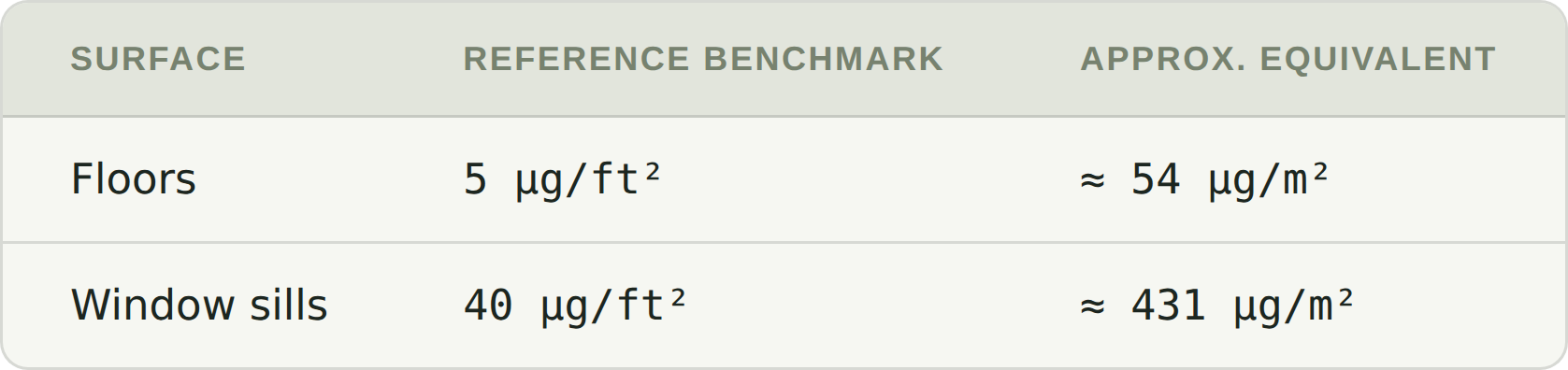
Figures shown are the US EPA/HUD post-abatement dust-lead clearance levels, effective under the EPA’s 2024 rule, used here as a professional reference point only. They are not a UK statutory requirement. Approximate conversion: 1 µg/ft² ≈ 10.76 µg/m².
Who this is for
Residential and commercial property, across the UK
Deliverable
What’s in your report
- Marked plan showing every sample location
- Individual results in µg/ft² and µg/m²
- Comparison against the applied benchmark
- Written interpretation of what the results mean for the property
- Recommendations: no action, re-clean and re-test, or specialist remediation
- Sign-off by a FOLPA-registered assessor
Frequently asked
Lead dust loading, explained
What is lead dust loading and how is it different from an XRF lead paint survey?
An XRF lead paint survey measures how much lead is present within a painted coating itself, reported as a percentage, mg/kg, or ppm. A lead dust loading assessment measures a different thing: the mass of lead dust that has actually settled on a surface, reported as µg/ft² or µg/m². Paint becomes a dust hazard once it is disturbed, friable, or deteriorating, so the two tests answer different questions and are often used together.
How is lead dust loading measured?
EnviroHive collects samples using specification wipe media over a defined template area on floors, window sills, and window troughs. Wipes are sent to a UKAS-accredited laboratory for analysis by ICP-MS or atomic absorption spectroscopy, and results are reported in both µg/ft² and µg/m² for every sample point.
Is there a legal limit for lead dust in UK homes or workplaces?
There is currently no dedicated UK statutory numeric standard for lead dust loading in residential or commercial property. Regulations such as CDM 2015 and the Control of Lead at Work Regulations 2002 govern how work involving lead paint must be planned, controlled, and carried out, but they do not set a dust loading figure. In the absence of a UK figure, EnviroHive references internationally recognised benchmarks, such as the US EPA’s dust-lead clearance levels, applying professional judgement to the property, its occupants, and the cause of any contamination.
When should I test for background lead dust levels?
Background or datum sampling is best carried out before any refurbishment, renovation, or demolition begins, particularly in pre-1992 or period property. It is also used at acquisition, before letting a property, or wherever a landlord, buyer, or managing agent wants a defensible reference point on file.
When should I test after refurbishment or renovation work?
Post-disturbance testing is appropriate wherever refurbishment or renovation has taken place without proper containment or respiratory protection, particularly sanding, dry scraping, heat-gun stripping, or demolition of coatings known or suspected to contain lead. It establishes how far contamination has spread and what level of cleaning or remediation is needed before the space is reoccupied.
How quickly will I get my results?
Laboratory-confirmed results are typically available within the same week of sampling. Where an indicative result is needed sooner, EnviroHive can carry out on-site XRF screening alongside wipe sampling to flag priority areas the same day, ahead of full laboratory confirmation.
Get in touch
Talk to a FOLPA-registered assessor
Tell us whether you need a background datum before works start, or an investigation following suspected disturbance, and we’ll scope the sampling plan from there.
Quick, free quotation


Asbestos Surveys
We undertake asbestos surveys as directed by UK legislation. We provide Management Asbestos Surveys & Refurbishment/Demolition Asbestos Surveys for all residential properties, commercial properties & industrial properties.

